
Cross-posting quietly costs you reach. Repurposing does not.
There is a version of "post everywhere" that costs you nothing and a version that quietly costs you most of your reach, and they look identical on a calendar.
The distinction is not how many platforms you post to. It is whether the file you upload was made for the platform you are uploading it to.
The penalty is real and it is silent
Social platforms do not, in general, punish you for saying the same thing in several places. What they do punish is uploading a file that is visibly second-hand.
Meta openly de-prioritises video that is visibly reused or carries another platform's watermark. The reported numbers are not marginal: reach reductions of up to 42% for repurposed content, and up to 72% where watermark remnants are detected.
The part that makes this expensive is that nothing tells you. There is no notification, no strike, no warning in the composer. The post simply does less than it should have, you conclude the idea was weak, and you never learn the file was the problem.
Aspect ratio is the second silent tax
The watermark is the famous one. Aspect ratio is more common and just as quiet.
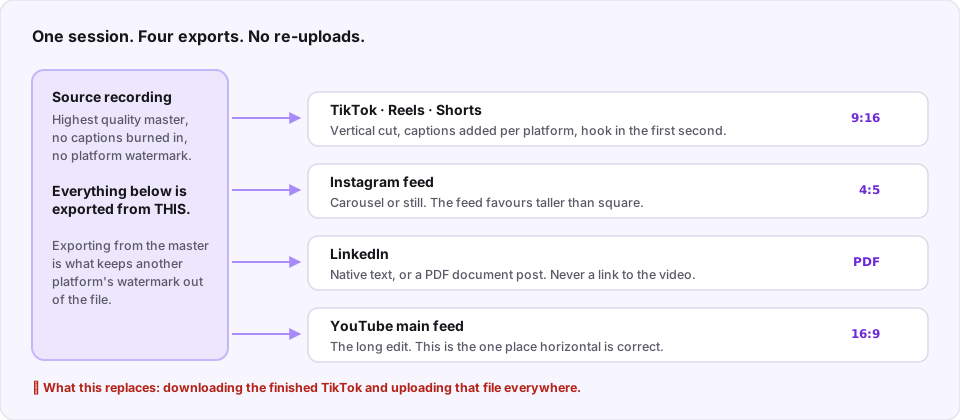
- 9:16 vertical — TikTok, Instagram Reels, YouTube Shorts
- 4:5 — the Instagram feed, which favours taller than square
- 16:9 — the YouTube main feed
Put a 16:9 clip into a 9:16 feed and you get black bars top and bottom. Nobody watches a letterboxed video to the end, the ranking system reads that low watch time as a lack of interest, and it stops showing it. You were not penalised for cheating; you were correctly measured as boring.
What repurposing actually means
Repurposing is not relinking one file in five places. It is reworking one idea for each platform on its own terms.
Concretely, for one recorded session:
- Export every cut from the master, not from a published post. This single habit removes the watermark problem entirely, because a watermark is only ever applied on the way out of a platform.
- Add captions per platform. Each burns its own style, and one platform's caption layout sitting inside another's frame is a visible tell.
- Rewrite the opening. A TikTok hook and a LinkedIn opening line are different jobs. The first has about one second; the second is read as text before anyone decides to expand it.
- Change the ask. "Follow for part two" belongs on TikTok. "What has your experience been?" belongs on LinkedIn.
The idea is shared. The file is not.
The workflow that makes this survivable
The reason people cross-post is not ignorance. It is that repurposing properly is four times the work at exactly the moment they have none left.
So the trick is to do it while you are already in the file, not later:
- Record or write once, deliberately over-capturing. A minute more of footage than the short cut needs.
- Export all cuts in the same sitting. You already have the project open, the assets loaded and the subject in your head. Coming back on Thursday to make the vertical version is how the vertical version stops happening.
- Schedule them out across the week rather than firing them simultaneously. The same idea landing in four feeds in one hour reads as a broadcast; spread over a week it reads as a theme.
- Keep the master. In six months you will want a different cut of it, and re-downloading your own post from a platform is how the watermark gets back in.
That last point is worth stating plainly: your media library, not the platform, is the source of truth. A file that has been through a platform has been through a compressor and a branding pass, and it should never be the input to anything.
What to check on your own account
If you have been cross-posting, you can usually see it in an afternoon:
- Sort your Reels by reach. Look at the bottom decile. Are they the ones that came from TikTok?
- Look for black bars in your own feed. If you cannot tell what ratio a post was, neither could the viewer.
- Check whether your worst-performing videos share an export path rather than a subject.
The correction is not more content. It is the same content, exported once more, from the right place.
Sources
- Conbersa — Cross-posting strategy for creators without getting penalised
- Blotato — Content repurposing mistakes that kill your reach
- Post-bridge — How to cross post to multiple platforms, 2026 guide
- PostEverywhere — Cross-posting vs content repurposing
Frequently asked questions
Does cross-posting hurt your reach?
Posting similar content to several platforms is not itself penalised. What is penalised is posting a file that carries another platform's watermark or is visibly reused. Instagram demotes Reels with visible TikTok watermarks, with reported reach reductions of up to 72% where watermark remnants are detected.
What is the difference between cross-posting and repurposing?
Cross-posting distributes the same file to several platforms. Repurposing reworks one idea into a native piece for each platform, exported separately from the original source. Repurposing takes longer and does not trigger reuse detection.
What aspect ratio should I use for each platform?
TikTok, Instagram Reels and YouTube Shorts want 9:16 vertical. The Instagram feed favours 4:5. The YouTube main feed wants 16:9. Posting a horizontal clip into a vertical feed produces black bars and low watch time, which suppresses reach on its own.