
A publishing system that survives your worst week
Almost nobody stops posting because they ran out of ideas. They stop because a launch collided with a conference and a sick child, and the two-week gap that produced was easier to extend than to explain.
Consistency is the thing that compounds on social, and it fails for operational reasons. So it needs an operational fix rather than more resolve.
The loop
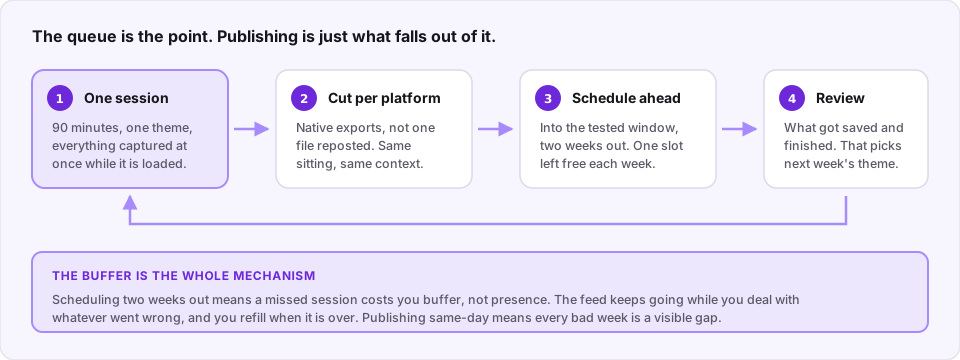
One session a week, 90 minutes, one theme. Not one post — one subject, with everything captured while the context is loaded in your head. The expensive part of content production is not writing, it is reloading the topic. Doing that once and harvesting four pieces is several times cheaper than doing it four times.
Cut it per platform in the same sitting. The project is open, the assets are there, you remember what you meant. Coming back on Thursday to make the vertical version is how the vertical version stops existing. (Why this matters more than it sounds: cross-posting versus repurposing.)
Schedule two weeks out. This is the mechanism the whole thing rests on, and it is covered properly below.
Review, and let that choose next week. Fifteen minutes on what got saved, shared and finished. Not likes — see the metrics post. The best signal for next week's theme is which of last month's actually held attention.
The buffer is the whole idea
If you publish what you made this week, then a week where you make nothing is a week where nothing appears.
If you are always working two weeks ahead, a missed session costs you buffer, not presence. The feed keeps running while you deal with whatever went wrong, and you refill when it is over. Nobody outside ever sees it.
That single change — same volume of work, moved forward a fortnight — is the difference between an account that has been going for three years and an account that has restarted four times.
Two weeks is the sweet spot for most teams. Deeper than that and the content starts going stale before it publishes; shallower and one bad fortnight still shows.
Leave one slot empty
A fully-booked calendar is a brittle one. Something genuinely worth posting about will happen — a launch, a customer story, an industry event, a competitor doing something interesting — and if there is no room for it you will either skip it or break the plan. In practice, people break the plan and then never quite rebuild it.
One empty slot a week costs you nothing and absorbs reality.
What the 90 minutes actually contains
A shape that works, adapt freely:
- 10 min — pick the theme. From last week's review, not from a blank page.
- 35 min — make the thing. Record, write, or capture the demo. Deliberately over-capture: a minute more footage than the short cut needs, a paragraph more than the post needs.
- 30 min — cut the variants. Vertical, feed, text. Native exports, each from the master.
- 15 min — schedule and review. Into the tested time window, spread across the week rather than fired together.
Ninety minutes, once a week, produces a genuinely consistent presence across two platforms. That is a smaller commitment than most content calendars assume and a much larger one than most teams sustain, because the calendar assumes discipline and this assumes an appointment.
Make it an appointment, not an intention
Put it in the calendar as a recurring block with a name. Treat it like a meeting with someone else, because the thing that kills it is always a meeting with someone else.
"Content batch — Tuesday 2pm" survives a busy week. "Post more on LinkedIn" does not.
When you are ahead, get further ahead
Counterintuitively, the best time to write is when you are already stocked.
The instinct on a light week is to relax, because there is nothing due. The correct move is to extend the buffer to three or four weeks. Buffer built in an easy week is what carries you through the hard one, and hard weeks do not announce themselves.
This is also the only realistic way anyone writes a quarter ahead. Not by finding a heroic free fortnight, but by being one week greedy about a dozen times.
What this looks like in a tool
Whatever you use, three things need to be true:
- You can queue far ahead without babysitting anything.
- You can see the whole queue at once, so you know how much buffer you actually have. A buffer you cannot see is a buffer you will not maintain.
- One piece of source media can go to several platforms without you re-uploading it four times.
Cybe Social does those three things — the calendar shows the queue, one media library feeds every platform, and an assistant can fill slots over MCP if you would rather describe a post than build one. But the system matters more than the tool. A shared spreadsheet and a recurring calendar block will beat the best scheduler in the world used sporadically.
The thing being optimised is not the posting. It is the number of weeks in a row you manage to keep going.
Sources
- Sprout Social — Best times to post on social media 2026
- Moon Product — AI content repurposing: one idea, every platform
- Sprout Social — 7 social media trends to know in 2026
Frequently asked questions
How do I stay consistent with social media posting?
Batch the work into one session a week and schedule it two weeks ahead. Consistency usually fails because posting depends on being free at the right moment every day. A weekly batch plus a queue removes that dependency, so a busy week costs you buffer rather than presence.
How far ahead should I schedule social media posts?
About two weeks for most teams. That is enough to absorb a missed session, an illness or a launch without a gap appearing in the feed, and short enough that the content is still current when it goes out.
Is it better to batch content or post daily in real time?
Batch, with room reserved for real time. Batching handles the 80% that is planned and gets the compounding benefit of consistency; an empty slot each week handles whatever actually happens. Relying entirely on real time means your output tracks how busy you are.