
The social metrics that survive a conversation with your CFO
Most social reporting fails in the same specific way: it answers a question nobody asked.
The deck says reach is up 34% and engagement is up 12%. The person reading it wants to know whether to keep funding it. Those are different questions, and the gap between them is why social budgets are fragile in a way that paid search budgets are not.
The fix is not to abandon engagement metrics. It is to know which tier you are in.
Three tiers
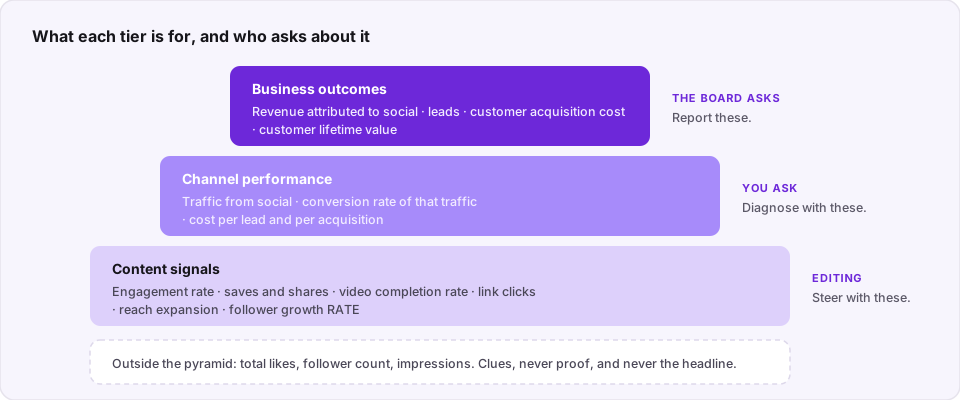
Business outcomes. Revenue attributed to social, leads generated, customer acquisition cost, customer lifetime value. This is the only tier that survives a budget conversation, because it is the only one denominated in the same units as the budget.
Channel performance. Traffic from social, conversion rate of that traffic, cost per lead and per acquisition. This is your diagnostic layer: when the top tier moves, this tells you which part moved.
Content signals. Engagement rate, saves, shares, video completion rate, link clicks, reach expansion. This is what you steer with week to week. It is not evidence of value; it is evidence of what to make next.
Everything goes wrong when a tier-three number is presented as a tier-one result.
Within content signals, some are much better than others
Engagement rate, not total engagement. Total engagement grows when your audience grows, so it will tell you things are improving during a period in which your content got worse. Rate controls for that.
Saves and shares, not likes. A like costs nothing and means little. A save is someone saying "I will need this later". A share is someone attaching their own reputation to it. Both predict downstream behaviour far better, and both are harder to farm.
Video completion rate. For any video format this is the metric the ranking system is effectively using, so it is the one that predicts distribution.
Follower growth rate, not follower count. Count is mostly a measure of how long the account has existed. Rate is a measure of whether this month worked.
Connecting the bottom to the top
The reason people report likes is not stupidity. It is that likes are handed to you and attribution is not.
Three things that get you most of the way without a data team:
Tag every link. UTM parameters on every outbound link, consistently, forever. Inconsistent tagging is worse than none, because it produces confident wrong numbers. Agree the naming convention once and write it down.
Add a how-did-you-hear-about-us field. One free-text or dropdown field at sign-up. It is unfashionable and imprecise and it catches the enormous amount of traffic that arrives with no referrer at all — the link someone pasted into a WhatsApp group, the post someone read on Tuesday and acted on the following Monday. Analytics calls this dark social and cannot see it; the customer will tell you if you ask.
Track assisted conversions, not just last click. Social is usually early in the path. Judged on last-click alone it will always look worse than search, because search is where people go once they already know your name — often because of a social post.
The honest caveat about attribution
Social attribution is genuinely hard and anyone claiming precision is selling something. People see a post on a phone, do nothing, search your brand from a laptop two weeks later and convert. No model captures that cleanly.
Which is an argument for humility in your numbers, not for retreating to likes. "Roughly 20% of trials name social when asked, and social-tagged traffic converts at 3.1%" is imprecise and useful. "Engagement is up 12%" is precise and useless.
A reporting shape that works
Weekly, for yourself: content signals. What got saved, what got finished, what died. Edit next week's plan from it. Nobody else needs to see this.
Monthly, for your team: channel performance. Traffic, conversion rate, cost per lead, plus the two or three posts that drove it and why you think they did.
Quarterly, for whoever funds it: business outcomes only. Revenue and leads attributed to social, CAC, and the trend. One slide. If you have done the first two consistently, this slide writes itself, and it is the one that keeps the budget.
What to stop doing
- Leading with impressions. Impressions measure how often a platform chose to show something, which is a fact about the platform.
- Reporting follower count as a result.
- Comparing engagement rate across platforms as though the denominators mean the same thing. They do not.
- Celebrating a viral post that brought no relevant audience. A hundred thousand views from people who will never buy is a bandwidth bill.
The test for any number in a report: if this moved 20% either way, would we do something differently? If not, it is not a metric. It is decoration.
Sources
- Hootsuite — Social media metrics to track in 2026
- Heropost — Social media analytics: the metrics that actually matter in 2026
- 123 Internet Agency — The end of vanity metrics: what real social ROI looks like in 2026
- InfluencerDB — Are social media vanity metrics still important in 2026?
Frequently asked questions
What social media metrics actually matter?
The ones tied to business outcomes: revenue attributed to social, leads generated, customer acquisition cost and customer lifetime value. Below those, channel metrics such as traffic from social and its conversion rate. Content signals like engagement rate, saves, shares and video completion rate matter for editing decisions, not for proving value.
Are likes and followers vanity metrics?
They are clues rather than proof. They do not correlate reliably with conversions, revenue or lifetime value, so they cannot carry a business case. They are still useful as early signals that something is or is not resonating, provided you never present them as the result.
How do I measure social media ROI?
Track social-attributed conversions: sign-ups, purchases or leads that originated from a social channel. Combine tagged links for click-through attribution with a self-reported how-did-you-hear-about-us field to catch the dark-social traffic that arrives with no referrer.