
Getting cited by ChatGPT and Perplexity: what actually changes
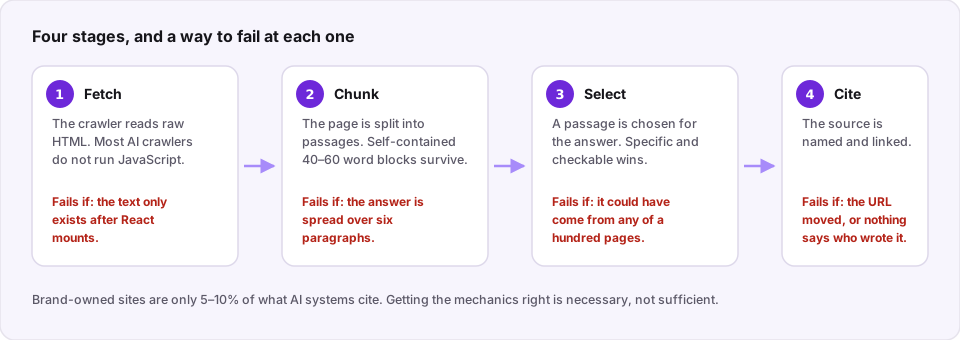
The single most useful number in this field: brand-owned websites make up only 5% to 10% of the sources AI systems cite.
Sit with that before optimising anything. Nine times out of ten, when an assistant answers a question about your category, it is quoting somebody who is not you.
The second most useful number is where the rest comes from. When Semrush analysed 100 million AI citations, Reddit appeared in nearly 10% of responses across ChatGPT, Google AI Mode and Perplexity — one forum, as often cited as all brand sites put together.
What this implies, before any tactics
AEO is not a page-level checklist bolted onto SEO. It is two jobs:
- Make your own pages extractable. Necessary, and entirely within your control.
- Be discussed where the citations actually come from. Harder, slower, and where most of the volume is.
Most guides only cover the first, because it is the part you can do on a Thursday afternoon. It is still worth doing properly.
The mechanics of a citation
Your page must be readable without JavaScript
This is the one that silently disqualifies whole sites.
GPTBot, ClaudeBot and PerplexityBot fetch HTML. They do not, in general, execute
JavaScript and wait for a framework to mount. A single-page app that renders
content client-side hands them an empty <div id="root">, and no amount of
writing quality changes that.
If your marketing site is a React or Vue app, check what curl sees. Not your
browser — curl. If the article text is not in that response, you are not in
the running.
(This is why the blog you are reading is server-rendered HTML with no bundle, which is unglamorous and load-bearing.)
Answer in 40 to 60 words, near the top of each section
The three structural moves that separate cited pages from invisible ones in 2026 are consistent across every credible analysis:
- A direct-answer block of 40 to 60 words at the top of every major section
- FAQ schema with question-shaped headings
- Named-entity density — specific products, companies, standards, versions
The reason is mechanical. A retrieval system splits your page into passages and selects one. A passage that answers the question completely, on its own, is selectable. An answer distributed across six paragraphs of build-up is not, because no single chunk of it says anything.
Write the answer first, then explain it. This is the inverse of how most people were taught to write, and it is the whole game.
Say things that could be wrong
Specificity is what makes a passage worth choosing over the ninety others covering the same ground.
"Instagram limits carousels" is unquotable. "The Instagram Graph API caps carousels at 10 children, while the mobile app allows 20" is a fact with a shape — checkable, attributable, and useless to paraphrase without the source.
Numbers, version strings, error messages, dates, named limits. That is what gets cited.
Structured data, matching visible text
FAQPage schema puts your question and answer in a form that needs no parsing
at all. Two rules:
- The answer in the schema must be visible on the page. Marking up content a visitor cannot see is a manual-action offence, and it is not a grey area.
- The question must be phrased the way a person asks it, not the way a marketer writes a heading.
Freshness is a ranking input, differently per engine
The engines have different appetites. ChatGPT leans toward authoritative long-form; Perplexity leans toward fresh, well-cited articles; Google AI Overviews pull from Google's index.
Practically: keep a real dateModified, update your best pages rather than
endlessly adding new ones, and cite your own sources. Perplexity in particular
favours pages that themselves cite.
The harder half: not being the source
Given that 5–10% figure, the uncomfortable conclusion is that your best AEO work may not happen on your domain.
- Be genuinely present where your category is discussed. For most technical products that is Reddit, Stack Overflow, Hacker News and a handful of newsletters. Not as a brand posting links — that is both ineffective and usually against the rules — but as people who answer questions.
- Make it easy to be described accurately. A clear, factual, boring page about what your product does, with the specifics on it, is what a third party quotes when they mention you.
- Get into comparison and listicle content, because those pages are disproportionately cited for "best X for Y" questions.
What to do this month
curlyour three most important pages. If the content is not in the HTML, fix that before anything else.- Add a 40–60 word direct answer under each main heading on those pages.
- Add
FAQPageschema for questions you can answer in two sentences, matching visible text exactly. - Put real numbers into your best page. Replace one vague claim with one checkable one.
- Check
robots.txtactually allows the AI crawlers. A blanket block added years ago for scrapers removes you from all of this, and nobody remembers it is there.
That last one takes thirty seconds and is the most common own goal in the category.
Sources
- Frase — Answer engine optimization: complete AEO guide 2026
- Powered by Search — AEO: how to rank on ChatGPT and Perplexity in 2026
- WRITER — GEO, AEO and SEO in 2026: the enterprise guide to AI visibility
- Bigeye — The complete guide to getting your brand cited by AI in 2026
Frequently asked questions
What is answer engine optimization?
AEO is structuring content so AI search systems such as ChatGPT, Perplexity and Google AI Overviews extract, quote and cite it when answering a question. Traditional SEO optimises for ranking position; AEO optimises for being the source a generated answer names.
How do I get my brand cited by ChatGPT or Perplexity?
Publish pages that a crawler can read without JavaScript, answer each question directly in 40 to 60 words near the top of its section, use question-shaped headings with FAQ schema, name specific entities, and keep the page current. Then work on being discussed on third-party sites, because brand-owned pages are only 5 to 10% of cited sources.
Do AI crawlers run JavaScript?
Mostly no. GPTBot, ClaudeBot and PerplexityBot fetch HTML and read what is in it. A single-page app that renders its content client-side serves them an empty container, so the page is effectively invisible regardless of how good the writing is.