
Two 2026 studies disagree about LinkedIn. Settle it on your own account.
Two things published this year about LinkedIn:
- Document posts are the highest-performing organic format, at 6.60% average engagement, generating two to three times the dwell time of text or image posts.
- Native text posts now beat carousels by 28% more reach and 34% better engagement for B2B, per a June 2026 analysis.
Both are presented confidently. Both come with numbers. They point in opposite directions.
This happens constantly in social media advice, and the useful response is not to pick the study that agrees with you. It is to understand why both can be right, and then to stop outsourcing the question.
Why both can be true
A study of social performance is not a fact about the platform. It is a description of a particular set of accounts, over a particular period, measuring a particular thing. Change any of those and the answer legitimately changes.
The samples differ. An analysis drawn from enterprise B2B accounts with established followings measures something different from one drawn from individual creators. Documents reward an audience willing to spend forty seconds swiping; text rewards one that skims a feed at speed.
The months differ. LinkedIn retunes continuously. A finding from February describes February. That is not a flaw in the research; it is the nature of a system being actively changed.
The metrics differ. One quotes engagement rate, the other quotes reach. Those can move in opposite directions at once: a format that reaches fewer people but grips the ones it reaches will show high engagement and low reach, and every word of both reports will be accurate.
Novelty decays. When a format is rewarded, everyone adopts it, the feed fills with it, and the advantage erodes. Some of the gap between these two findings is simply the carousel becoming ordinary.
The mechanism worth keeping
Underneath the disagreement there is a stable insight, and it is more useful than either number: LinkedIn rewards dwell time.
Documents win when they win because each slide is a small engagement event and people spend 30 to 60 seconds swiping. That is the actual mechanism. It implies something a headline does not — that a bad ten-slide carousel is worse than a good text post, because it produces swipe-away, not dwell.
Which means the format question is downstream of a content question. A tactical, specific document with a real framework will hold someone for a minute. A document made because documents perform well will not, and the format cannot save it.
The test
Eight weeks. Two posts a week. Alternate the format weekly.
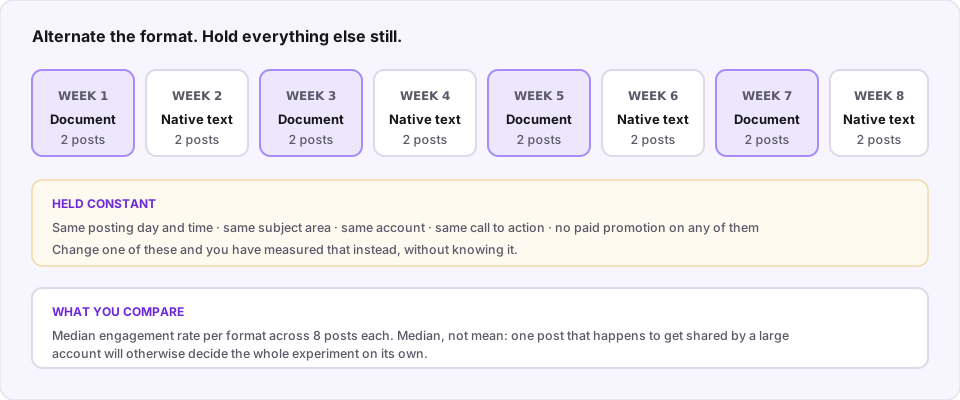
Hold constant: the posting day and time, the subject area, the account, the call to action, and whether anything is promoted. Change one of those and you have measured that instead, without realising it.
Alternate by week, not by post. Weekly blocks stop a good news week or a conference from landing entirely on one format.
Compare medians, not averages. This is the single most common mistake. One post picked up by a large account produces a number that drags the mean for its whole format and tells you nothing repeatable. The median is what you can expect next time.
Use engagement rate, not raw engagement, so follower growth during the test does not read as a format effect.
Eight posts per format is not a clinical trial. It is enough to see a real difference if there is a large one, which is the only kind worth changing your strategy over.
Reading the result honestly
If one format wins by a wide margin, take it, and re-run the test in six months because the platform will have moved.
If it is close, that is a genuine result and a useful one: it means format is not your constraint. Stop optimising it and go work on the thing that is — usually the subject, the specificity, or how often you show up. Accounts spend months A/B testing formats when the honest finding was that both were fine and the content was the problem.
The production cost nobody prices in
One thing the studies cannot tell you: a document post costs perhaps forty minutes to make properly, and a native text post costs ten.
If documents win by 20% but cost four times as much, text may still be the right answer for you, because the alternative use of those thirty minutes is another post. Frequency and format trade against each other, and only you know your budget.
Run the test on your own account. Two studies disagreeing is not a reason to guess; it is a reason to measure.
Sources
- Oktopost — LinkedIn carousel best practices for B2B in 2026
- Dataslayer — LinkedIn algorithm 2026: what works now
- Markana Media — LinkedIn algorithm June 2026 and B2B reach
- Digital Applied — LinkedIn algorithm 2026 engagement strategy guide
Frequently asked questions
Do LinkedIn document carousels still work in 2026?
The evidence is genuinely mixed. One 2026 dataset reports document posts as the highest-engagement organic format at 6.60%, with 2 to 3 times the dwell time of text or image posts. A separate June 2026 analysis found native text posts outperforming carousels by 28% reach and 34% engagement for B2B. Which applies to you depends on your audience, so test both.
Why do social media studies contradict each other?
Because they sample different accounts over different periods, and platform ranking changes between them. A study is a description of a particular set of accounts at a particular time, not a rule about the platform. Directional agreement across several studies is meaningful; a single figure is not.
How long should I run a content format test?
At least eight weeks with a consistent cadence, which gives roughly eight posts per format. Anything shorter is dominated by noise, because engagement on a single post varies enormously for reasons that have nothing to do with format.